
By the height of December, when the air finally turns (and stays) chilly and the sun sets by 5 p.m. on the west coast, it means it’s finally time to just snuggle up at home and watch a good holiday movie. But what makes people want to watch these festive films, and what films are people really watching?
Popular movies
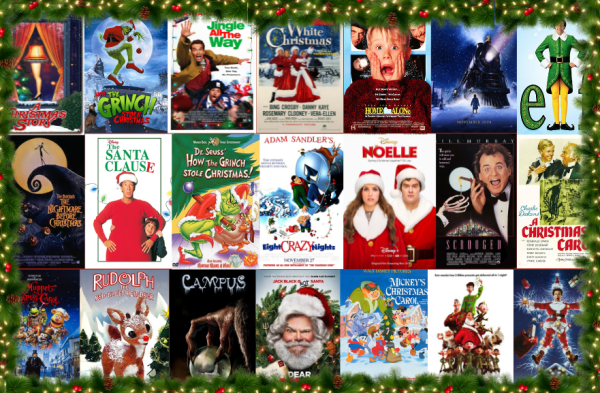
Some say that classic holiday movies are the best; movies like “A Christmas Story,” “Home Alone,” and “It’s a Wonderful Life” are critically acclaimed for their similar themes of the value of family and community. Popular holiday movies often share these heart-warming thematic concepts. This could be why people are drawn to watch these movies, especially when watching with family and friends. This feeling of watching a feel-good movie with the people you love brings people together, especially during the holiday season.
“I think a good holiday movie requires an actual feeling of Christmas and a feeling of family and warmth and togetherness,” said Bailey Shih, a freshman at Huntington Beach High School (HBHS).
“The whole point of the holidays is to be with your friends and family, and the movies are just a way to bring those together. Like in ‘The Nightmare Before Christmas,’ I love how Sally and Jack have this bond that, though not explicitly stated, it’s kind of there, and they relate to each other in some way, which I think is good to show togetherness in holiday movies,” Shih said.
Another popular trope in holiday movies is the idea of a “not-so-perfect family.” Movies like “Love Actually,” “National Lampoon’s Christmas Vacation,” “Home Alone” and “The Santa Clause” all share this tried and true story line. This is another plot point many families can relate to.
“Bad” movies
Most classic holiday movies are popular for these common tropes, good music and creative casting, but other movies are well known for actually being bad. For example, sequels made of holiday movies often lose the nostalgia and originality that the first film had, resulting in lower IMDb scores.” The Santa Clause 3: The Escape Clause,” “Home Alone 4,” and ”Home Alone 3” are all examples of sequels that are famously “bad.”
With the annual popularity of the original films, movie studios often try to recreate this with a second, third and even fourth movie. Most sequels fall flat compared to the original films, with the use of similar plot points but missing the important originality that the first movies had; this often makes them seem “ predictable” or “uninspired.”
Joaquin Radel, a freshman at HBHS, said, “I think it’s all materialistic slop packaged in a bow where everything just comes together in an over-sanitized and unrealistic ending. The movie studios just want to have the same amount of success that the first movies got and don’t care about the end product.”
Hallmark movies
Hallmark movies are made-for-TV films produced by the Hallmark Channel; they’re also known as “bad” holiday movies. They are known for having similar storylines, in which two people fall in love during the holidays, and find a warm and cozy happy ending. Although predictable and nearly identical, these movies consistently earn over $350 million each year.
Anna Mackulin, a sophomore at HBHS, said, “I love Hallmark movies. I used to sit down on the couch to watch them with my mom. They are so cheesy but so much fun. My favorite has always been ‘A Cookie Cutter Christmas.’ I love the happy endings in the movies, even if they are predictable.”
In the end, it’s a combination of nostalgia, family values, and a happy ending that makes a good holiday movie. But what truly makes the best holiday movie is the friends and family you surround yourself with while watching them.