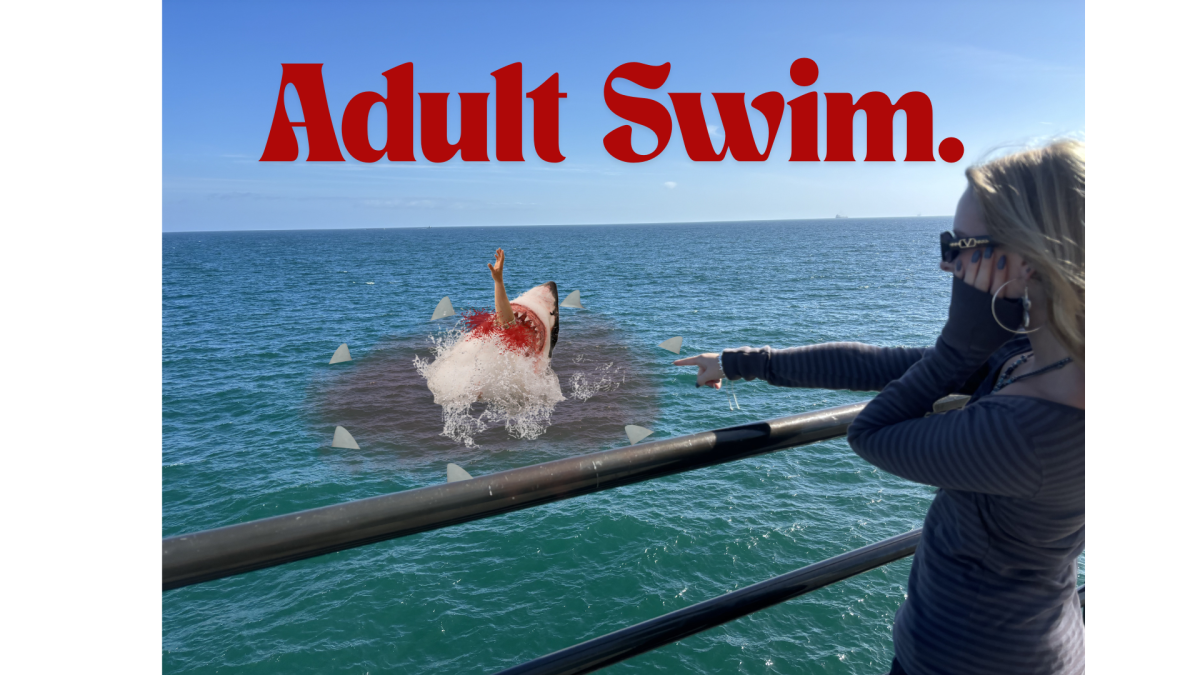
Summer. The time for the sun, sand and ocean. Humans have always enjoyed a good beach day—especially during the lovely season of summer, when the weather is nice and the days are easy. Of course, 1970s Hollywood saw the public’s adoration of the beach and realized an important fact: they had something new to capitalize on. Not only could there be movies about the joys of parties on the sand, but there were also new opportunities to exploit people’s fears. How fun!
Thrillers about the beach—and the ocean by proxy—typically center around one main character: sharks. The genre of shark movies, also known as the sharksploitation subgenre, is one that often mixes horror with comedy. The genre also happens to have the reputation of being unforgivably cliche.
Since 1975, when “Jaws” (an adaptation of Peter Benchley’s same-titled book, written a year prior) was released in theaters, movie makers have been synonymous with sharks swimming through chummed waters: hungry and curious.
This Stephen Spielberg work became more than just one good shark movie. Yes, there was “Jaws 2,” “Jaws 3” and “Jaws: The Revenge,” but other than just sequels, there was also a new market. Directors from all walks of life desired a similar hit as “Jaws,” so they followed Spielberg’s formula: ocean, boat and big shark.
And there it is—the perfect movie.

When thinking of shark films, some titles that come to mind (other than “Jaws”) may be “47 Meters Down,” “The Meg” or “Sharknado.” These films share the same motif (big shark), but they go about the storyline in unique ways. “The Meg” focuses on the prehistoric, gargantuan shark that was the apex predator of the ocean pre-extinction. “47 Meters Down” depicts the very common reality of two tourists doing something reckless and facing the consequences; in this case, they get trapped 47 meters beneath the ocean’s surface, surrounded by sharks. “Sharknado” is about a bunch of sharks flinging around as part of a massive shark-tornado.
It’s obvious that there’s a wide variety of options in this subgenre. Some movies lean more towards the horror aspect (such as “Thrash,” a new Netflix film that mixes hurricanes with bull sharks), while others go in the comedy direction (like “Shark Exorcist,” which mixes Satan, possession, bikini-clad women and great white sharks). This is what makes shark films so beautiful. When it comes to making a story centering around a big ol’ shark, creativity knows no bounds. Already, there’s a draw to the movie – who doesn’t want to watch a large shark cause mischief? There’s also the immediate promise to the audience that they are either going to be amazed by the special effects (both real and CGI), or they are going to be in disbelief of how bad it is.
Luke Martucci, a sophomore at Huntington Beach High School (HBHS), said, “I was more curious about how bad the CGI would look for, like, ‘6-Headed Shark Attack,’ but for ‘Jaws’ I feel like a main appeal is the suspense ‘cause the water is darker and so deep where you can’t really see what’s underneath. It creates a more scary atmosphere.”
A Biting Reality
Unfortunately, the sharksploitation subgenre didn’t get its name just because it sounded cool. The entire genre is built upon a foundation of misinformation and misplaced fear about the reality of sharks. “Jaws” would never have been made if Benchley didn’t believe in Dr. Victor Coppleson’s theory of the Rogue Shark.
The Rogue Shark is, in layman’s terms, a maneater. It’s the title for a shark that has tasted human blood and wants more. Coppleson, an Australian surgeon who managed to permanently taint the public’s perception of sharks with his book titled “Shark Attack,” believed that sharks unable to hunt their regular prey of fish and crustaceans would rely on humans for their meals. This theory was later proven to be false.
Dr. Chris Lowe, a professor of marine biology and the director of the Shark Lab at Cal State. Long Beach, said, “There’s been a bunch of social science studies done that showed how ‘Jaws’ kind of changed people’s perceptions of sharks, making them fearful, which made it easier for people to kill them. So, in other words, it made it easy for fisheries to allow them to be overfished because, y’know, the fishermen were arguing, ‘Well, we’re making the water safer.’”
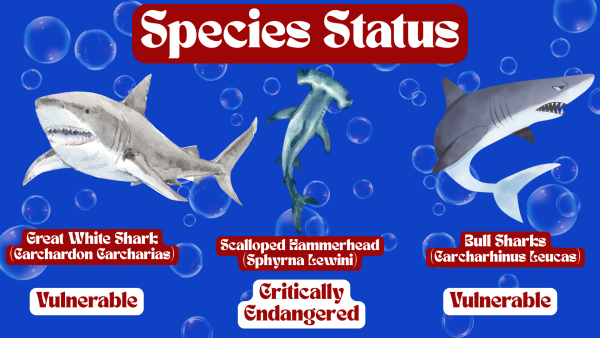
Here’s the truth: last year, there were a total of 65 unprovoked incidents of shark bites around the globe, nine of which were fatal. On the other hand, humans kill 100 million sharks per year.
One of the main perpetrators of villainizing sharks is, unfortunately, the Discovery Channel. Known for their annual Shark Week that began in 1988, the channel spends a week of Summer focused purely on shark-centric television. To the average shark lover, this may sound like a dream come true. Sadly, this is more of a shark’s worst nightmare. Shows titled “Great White Assassins,” “Florida’s Death Beach” and “Attack of the Devil Shark” are all from 2025’s Shark Week lineup. Sharks are depicted as these monstrous beings made to hunt innocent people, not as the simply curious fish they really are.
Dr. Lowe said, “I’ve been in quite a few Shark Week shows, going back 20+ years, and about ten years ago I stopped. I just couldn’t do it anymore. They weren’t interested in the science, they weren’t interested in the truth or accuracy, they just wanted to entertain an audience. So, in that, I just couldn’t agree with it. And it was going against all the things [the Shark Lab was] trying to change—people’s, y’know, gross fear of sharks.”
When asked about what the most dangerous thing in the ocean was for a surfer, Hira Gomibuchi, a sophomore at HBHS and longtime surfer, said, “To be honest, it’s yourself. One, because you have a surfboard, which can pierce your face, eye, there’s a lot. And also just ‘cause you have to be careful of your surroundings, as well.”
This isn’t to say that sharks aren’t dangerous and that attacks aren’t serious events, but it is necessary to remember that more humans actively hunt sharks than sharks hunt humans. Finning, the practice of catching a shark to cut off its dorsal fin and leave the rest of its body to sink in the ocean, remains a thriving industry.
Take it from Benchley himself, who spent the last 40 years of his life attempting to undo the harmful stereotypes that “Jaws” encouraged by becoming an ocean conservationist. He has worked with National Geographic to shed a new, kinder light on sharks. Despite passing away in 2006, Wendy Benchley, Benchley’s wife, continues to uphold his legacy of ocean advocacy.
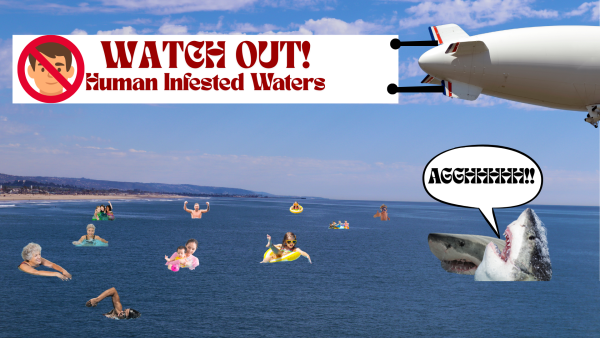
Shark movies should be watched by an audience who love sharks. That is who this genre is for. The glory of “Jaws” is Bruce, the crew’s name for the animatronic shark playing the main antagonist. People don’t watch the movie for Officer Brody or even Quint the fisherman—they watch it for the big shark. That’s the draw of literally any shark movie; it’s why the films don’t necessarily have to be good in order to be successful. No one is watching “The Meg” for Jason Statham on a jet ski. They are watching because seeing a big fish with big teeth is cool.
Well, one thing’s for shore, sharks need to be shell-ebrated for their fin-tastic impact on the ocean. They help maintain a stable food web in the sea, preventing coral reefs from being overpopulated. They also encourage sea creatures to travel (as a way to escape the sharks), which protects seagrass meadows from being overgrazed by sea turtles and other animals of the like. Fish genetics are also aided by sharks, as they make sure to eat the weakest ones first.
Sharks have been around for at least 410 million years and will continue to exist after the earth implodes and all that’s left is an ocean, so it only seems right for the human race to give them the respect they de-surf.