
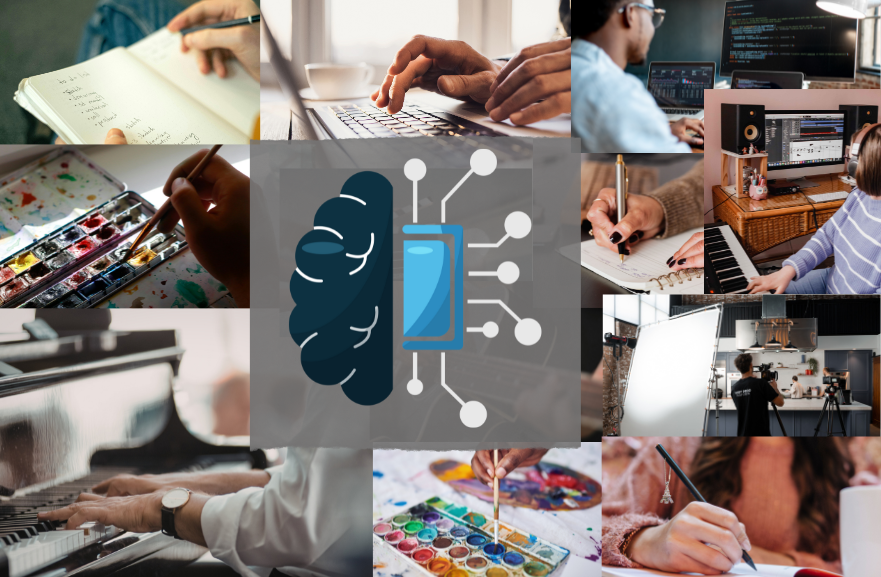
Artificial intelligence (AI) is reshaping life in ways that felt unimaginable just a decade ago. What started as software designed to automate basic tasks has grown capable of writing essays, producing art, composing music and generating full videos in just minutes. This raises serious concerns about the future of job stability and cultural representation in the media. Creatives across every field worry that AI won’t work beside them as a collaborator, but instead replace them completely. The fear goes far beyond job loss—it points to a deeper worry that AI-generated work could weaken cultural diversity and encourage increasingly uniform artistic styles in the media.
Technology has historically disrupted creative fields, but has never fully replaced human labor. For example, the internet and digital editing reshaped journalism, but reporters remained necessary. Music software has transformed production, but musicians and producers are still essential to the process; the list goes on.
AI stands apart from these examples because it can replicate human style at unmatched speeds. It has the ability to generate thousands of images, songs and written works instantly without the lived experience or emotion that makes creative work feel meaningful. Seventy-three percent of employees want their company to implement AI across their organization, according to a study by Workday Jobs, showing how quickly concerns about job displacement, reduced job security, and the long-term value of human labor are being pushed aside. In fact, 30% of current U.S. jobs could become automated by 2030.
The implications reach far beyond employment. Creativity shapes culture and helps communities understand themselves on a deeper level. If AI-generated content becomes the main source of media that people consume, society will lose a human perspective that can’t be replaced. Millions of working citizens rely on creative work for economic stability, so protecting these jobs means protecting their livelihood.
AI itself is not the enemy. The real issue is what happens when AI enters creative industries without guardrails and begins replacing humans rather than helping them. Using AI as a tool requires thoughtful guidelines that allow it to support human creativity rather than replace it.
This is not resistance to innovation. It’s a commitment to preserving artistic integrity and protecting workers. With responsible regulation, society can benefit from new technology without sacrificing the originality, depth and dignity that only people can create.
AI has already begun shifting the career landscape for creative workers. It brings efficiency and fresh ways to experiment, yet it also brings the threat of removing people from the industries that depend on originality and lived experience. In art, music, writing and video game design, AI isn’t just changing how work is created, but who gets to create it. These shifts matter because once society begins losing space for creative development, entire industries lose the human touch that gives art its true meaning.
Visual Arts
AI art programs like DALL-E, Artlist and Stable Diffusion can create thousands of polished images by training on enormous datasets of human artwork. Designers and advertising teams use them because they save time and money, however it disregards artists who depend on commissioned work. Fifty-five percent of professional artists nationwide feared losing income due to AI, and 61% believed AI threatens the originality of creative work. Another growing concern is the rise of AI influencers and online accounts that pass AI images off as original art. Many of these images mimic the recognizable style of living artists whose work was scrapped without consent. Like Kelly McKernan, her name was used to generate AI images and to recreate her art. Artists have reported that AI outputs are so close to their personal styles that viewers often assume the human artist copied the AI. While AI can replicate aesthetic choices, it cannot generate emotional depth. Heavy reliance on machine-generated images risks flattening artistic expression until everything looks repetitive and recycled.
Music
The music world faces similar challenges. AI tools like OpenAI’s Jukebox, Aiva and Amper can produce audio tracks that sound almost identical to real musicians. An example of this is Sienna Rose, an AI-generated music “artist” with songs available for streaming. The song “Where Your Warmth Begins,” released in February, currently has 20 thousand streams on YouTube.
Companies use these tools to create background music quickly, threatening the livelihood of composers and session musicians. A survey found that 35% of respondents (based in Europe) have already used some form of AI in their music creation work. Since many AI systems train on copyrighted songs without permission, the problem expands from economic loss to ethical violation. Without regulation, AI could saturate streaming platforms with predictable and formulaic tracks, making it even harder for new voices to be discovered. Music relies on emotion and life experience, if the industry starts favoring AI outputs, the emotional and cultural layers that make music powerful could fade.
Writing and Journalism
Writing has been hit hard by new AI tools. Systems like GPT4 or Jasper can produce articles, essays and creative stories in seconds. Although helpful for brainstorming or outlining, these tools pose a threat to entry-level journalism jobs, which have traditionally served as a starting point for young writers. Forty-three percent of journalists worry that AI will replace traditional reporting roles. AI also raises concerns about the spread of misinformation and bias. Many outlets use AI in the writing process without disclosing this to their audiences, which can erode trust. Because AI reflects the biases in its training data, it can unintentionally misrepresent communities or political issues. As deepfake images and misleading AI-generated visuals spread, especially during elections, the foundation of accurate reporting becomes less stable.
Video Game Design
Video game studios, like Mojang, now use AI to build landscapes, characters and even write dialogue. This speeds up production but eliminates jobs for junior designers and writers who used to learn through hands-on work. Game developers are concerned about the ethics of using generative AI. The backlash against the AI-backed release of “Call of Duty: Black Ops 7,” highlighted the enduring importance of human creativity to players. When fans discovered that parts of the game utilized AI-generated assets without transparency, many criticized the studio for outsourcing human artists. Players described the AI assets as flat and lacking personality, which shows that audiences still want games shaped by human imagination.
Ethical Considerations
The ethical challenges surrounding AI reach far beyond creative jobs. One major issue is how AI systems are trained. Generative AI models learn from massive datasets that often include copyrighted artwork, writing and music used without permission. This raises questions about ownership and compensation.
Researchers argue that when creators’ work is used to train AI without credit, the system becomes a form of creative exploitation. AI also risks weakening cultural diversity. Creativity comes from lived experience, emotional memory and cultural background. Machines cannot replicate those qualities. If AI becomes the dominant form of production, creative expression could become homogenized and make it harder for underrepresented cultures to remain visible. Labor ethics add another layer. Many creatives worry about being replaced entirely, losing income and having fewer opportunities to develop skills.
“Creative workers are worried about being replaced, losing their sources of income and having fewer prospects for professional development,” said Smith.
Without regulation, AI adoption could exacerbate economic disparities and erode entire creative professions.
What to do about it?
There are several steps policymakers can take to protect creative workers. Copyright reform could require companies to credit and compensate creators when their work is used in AI training. Education programs can help artists and writers learn how to collaborate with AI while maintaining creative control. Unions and creative organizations can advocate for fair standards, provide training and amplify the concerns of professionals. Policymakers should also involve creators directly in the drafting of new regulations to ensure that the rules align with the real needs of the industry. As Smith said, collaborative policy making ensures that guidelines are both practical and ethical.
Artificial intelligence doesn’t have to undermine human creativity. With solid regulations and ethical standards, AI can support expression while preserving cultural value. Human creativity depends on lived experience and emotional insight, qualities machines can’t replicate. By promoting transparency, protecting workers and prioritizing originality, society can ensure AI strengthens creativity rather than replaces it. Protecting creative labor protects cultural meaning and, when handled responsibly, AI can expand imagination instead of overshadowing it.